


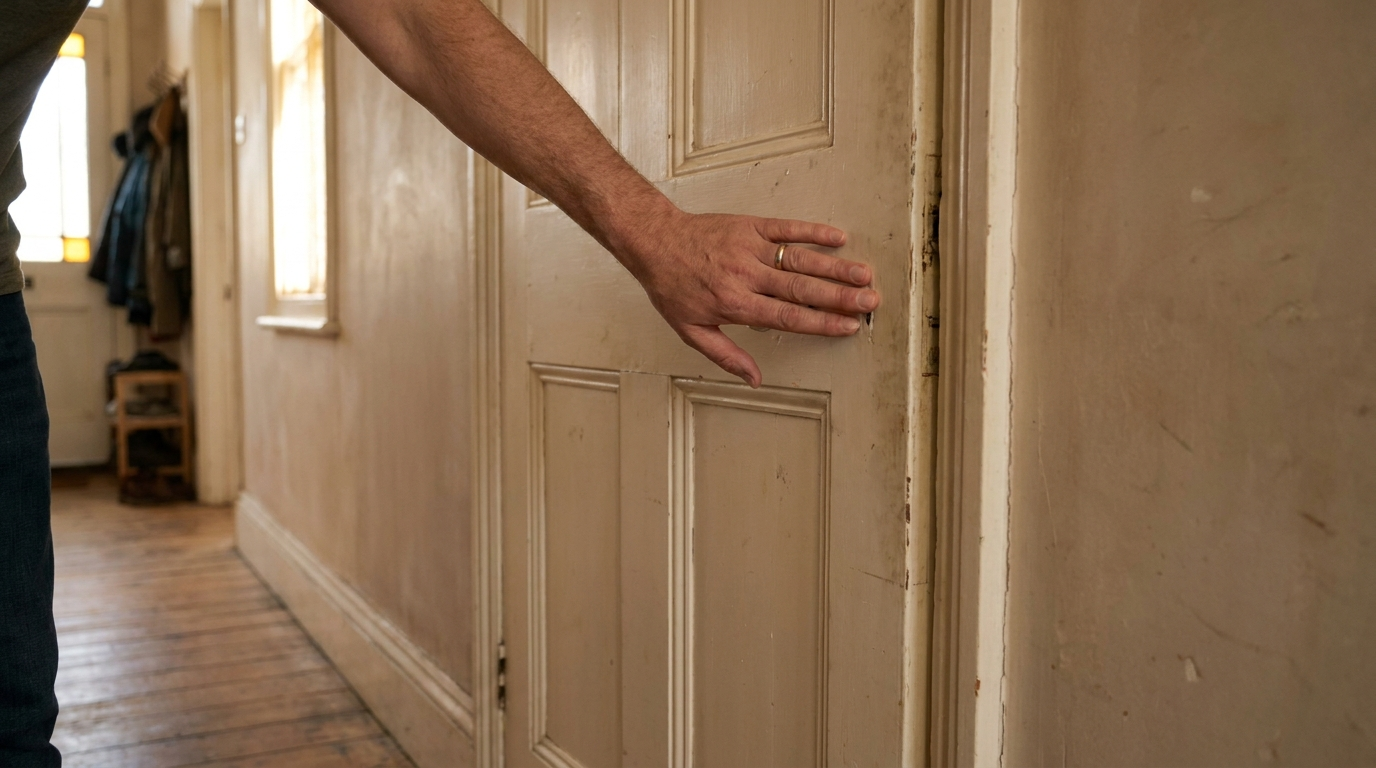
There's a particular kind of British summer annoyance that nobody warns you about: the door that suddenly won't shut. One week it's fine, the next you're putting a shoulder into the bathroom door like you're in a police drama. If you live in one of Bristol's older terraces, you'll know exactly what we mean.
Good news — most sticking doors have a simple cause, and a decent number of them you can sort yourself in an afternoon. Here's how to work out which one you've got.
Why doors stick in the first place
Wood is stubbornly alive. It absorbs moisture from the air and expands, then dries out and shrinks again. A humid spell — muggy summer days, a bathroom without decent extraction, drying washing indoors — is enough to swell a timber door by a millimetre or two, and a millimetre is all it takes to turn a smooth close into a shove.
But humidity isn't the only culprit. The other usual suspects are:
- Loose hinge screws. Easily the most common cause. Screws work loose over years of slamming, the door drops slightly, and the top corner starts catching on the frame.
- Paint build-up. Old Bristol houses can carry a decade's worth of gloss on the door edge and frame. Each coat is thin; ten coats aren't.
- New flooring. Carpet, LVT or engineered boards laid over the old floor raise the level, and the door now drags at the bottom.
- Settlement. Old houses move. A slightly out-of-square frame in a Victorian terrace is normal, not a crisis.
Find out where it's actually catching
Before you reach for the sandpaper, do the paper test. Close the door slowly and watch where it makes contact, or slide a sheet of paper around the gap and see where it snags. Then check the pattern:
- Catching at the top of the latch side — almost always a sagging door, so start with the hinges.
- Catching down the whole latch edge — swelling or paint build-up.
- Dragging along the bottom — new flooring, or a swollen bottom rail.
Five minutes of diagnosis saves you planing a door that never needed planing. Once wood's off, it doesn't go back on.
The fixes worth trying yourself
Tighten the hinges. Start here every time. If a screw just spins without biting, the hole's worn — pack it with a wooden matchstick or a bit of dowel and a dab of PVA, let it set, then re-screw. It's an old trick because it works.
Shim the bottom hinge. If the top corner is catching, loosen the bottom hinge, cut a piece of thin card to the size of the hinge recess, tuck it behind and screw back up. That tiny shim tilts the door back into square.
Sand the sticking spot. For light swelling, a bit of medium-grit paper on the exact contact point does the job. Go slowly and keep testing. And seal any bare wood afterwards with paint or varnish, or it'll drink in moisture and swell again next summer.
Sort the damp air. If doors stick all year rather than seasonally, the door isn't the problem — moisture is. Extractor fans that actually vent outside, opening a window after showers, and drying washing outdoors do more than any amount of sanding.
Myth-bust: "just plane a bit off"
It's the standard pub advice, and it's the one that costs people money. Plane a swollen door in August and you'll have a draughty, rattling door with a finger-wide gap by December when the wood dries back out. Worse, planing a fire door — the heavier doors often required in flats and HMOs — can compromise its rating and cause you real problems at inspection time. If the door's sticking seasonally, fix the fit, not the door.
When to call a carpenter
Hand it over if the frame is visibly out of square, the door is a fire door, it's a heavy or expensive external door, or you've tightened, shimmed and sanded and it still catches. A Bristol carpenter will typically charge somewhere in the region of £25–£60 an hour, or roughly £150–£350 a day, and easing and re-hanging a door is usually a job of an hour or two rather than a full day. Rehanging a door properly on an existing frame tends to land around £120–£250 in labour. As ever, these are typical ranges rather than fixed prices — the state of your frame moves the number.
If it's one of a list of small niggles, a handyman can often knock several out in the same visit, which works out far better value than booking three separate trades.
Get it sorted without the faff
Post the job on Phixed with a photo and a quick description, and verified local Bristol trades send you quotes — you pick on price, ETA and rating. Everyone on the platform is verified and insured, payment is held securely via Stripe until the job's done, and reviews only come from completed jobs, so what you're reading is real. No ringing round, no hard sell.
Download Phixed on the App Store or Google Play — then get the kettle on while the quotes come in.